uBixOS
OPEN SOURCE 64-BIT OPERATING SYSTEM — ARM64 + x86_64 — SINCE 2002
After 20+ years on 32-bit i386, uBixOS made the jump to a clean 64-bit codebase. The kernel now boots to the full graphical desktop on ARM64 (aarch64) — the new primary architecture — and x86_64, sharing one machine-independent kernel and userland. Same compositor, same apps, two 64-bit CPUs.
The NetSurf browser runs in-OS on all three arches — HTML/CSS with JavaScript, over TLS and a live TCP/IP stack.
Both boot to login, mouse, and an interactive tcsh desktop. i386 is retired to a legacy branch.
musl pthreads on a homebrew kernel: pthread_create, mutexes, condvars, and futex-backed sync.
Secondary CPU cores come out of reset and run 64-bit kernel code — the road to true multi-core.
The gold standard of OS maturity. uBixOS boots, loads the WAD, and renders a full game at playable frame rates — windowed inside the Views compositor or fullscreen. The same kernel that handles memory management, input, and audio is the one E1M1 is running on — now on ARM64 and x86_64 alike.
[ SCREENSHOTS ]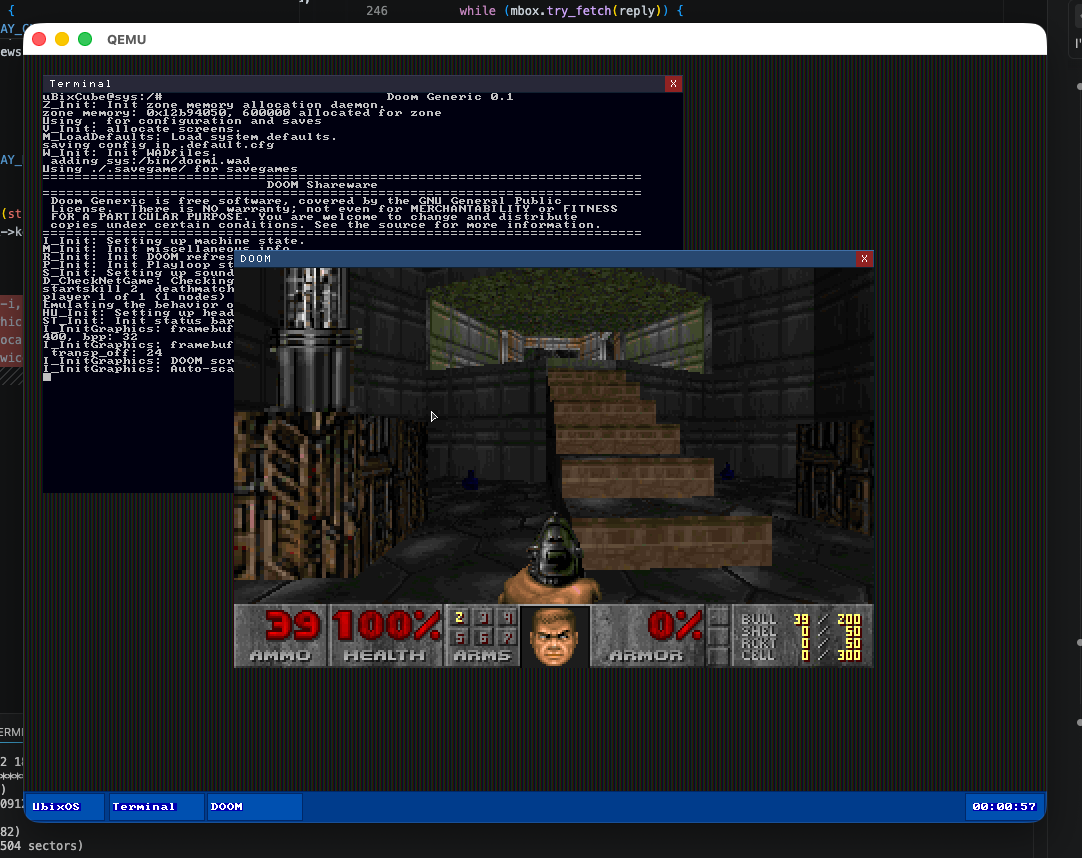
32-level priority bitmap scheduler with real-time and background QoS tiers. Context switches in constant time regardless of task count.
Copy-on-write fork, demand-zero anonymous pages, RB-tree VMA lookup for O(log n) mmap/munmap, and a clock-algorithm swap daemon.
Views compositor with overlapping windows, a taskbar, application launcher, and login screen. Run Doom and Tessera side-by-side.
Intel AC97 audio codec driver with DMA playback. Doom's soundtrack plays through the same kernel that boots the OS.
One machine-independent kernel + userland over a thin arch layer. The same source boots on ARM64 (virt + GICv2) and x86_64 (APIC + virtio) — with real-hardware ARM boards next.
musl libc 1.2.5 ported and running. ELF dynamic linker loads shared libraries at runtime — the same way Linux does it.
Every account defaults to tcsh 6.24.16 — tab completion, history, job control. busybox 1.36.1 backs a full coreutils suite plus vi: grep, find, less, sort, cp, mv, and more.
Full POSIX signal delivery: sigaction, sigprocmask, sigsuspend, SA_SIGINFO frames, SA_RESTART, and process groups. Ctrl-C works.
DOOM (windowed + fullscreen) and Tessera — a Tetris-inspired puzzle game in the Views compositor. Two playable games on a homebrew kernel.
Per-user wallpapers, solid/jailbars backgrounds, and an accent color that themes the whole taskbar and window chrome. Ships with original synthwave art.
In-kernel lwIP over virtio-net with DHCP, a BSD sockets API, and userland tools — wget, httpsget (BearSSL), and nc — feeding the NetSurf browser.
A hierarchical, typed config registry persisted to disk and served over MPI. Backs the desktop, theming, start menu, and network settings — with per-user layering.
macOS + Homebrew or Linux. Clone, run bmake image, boot in QEMU. Detailed guide inside.
Follow along, file issues, send PRs. Every star helps a 20-year project stay visible.
[ GITHUB ]